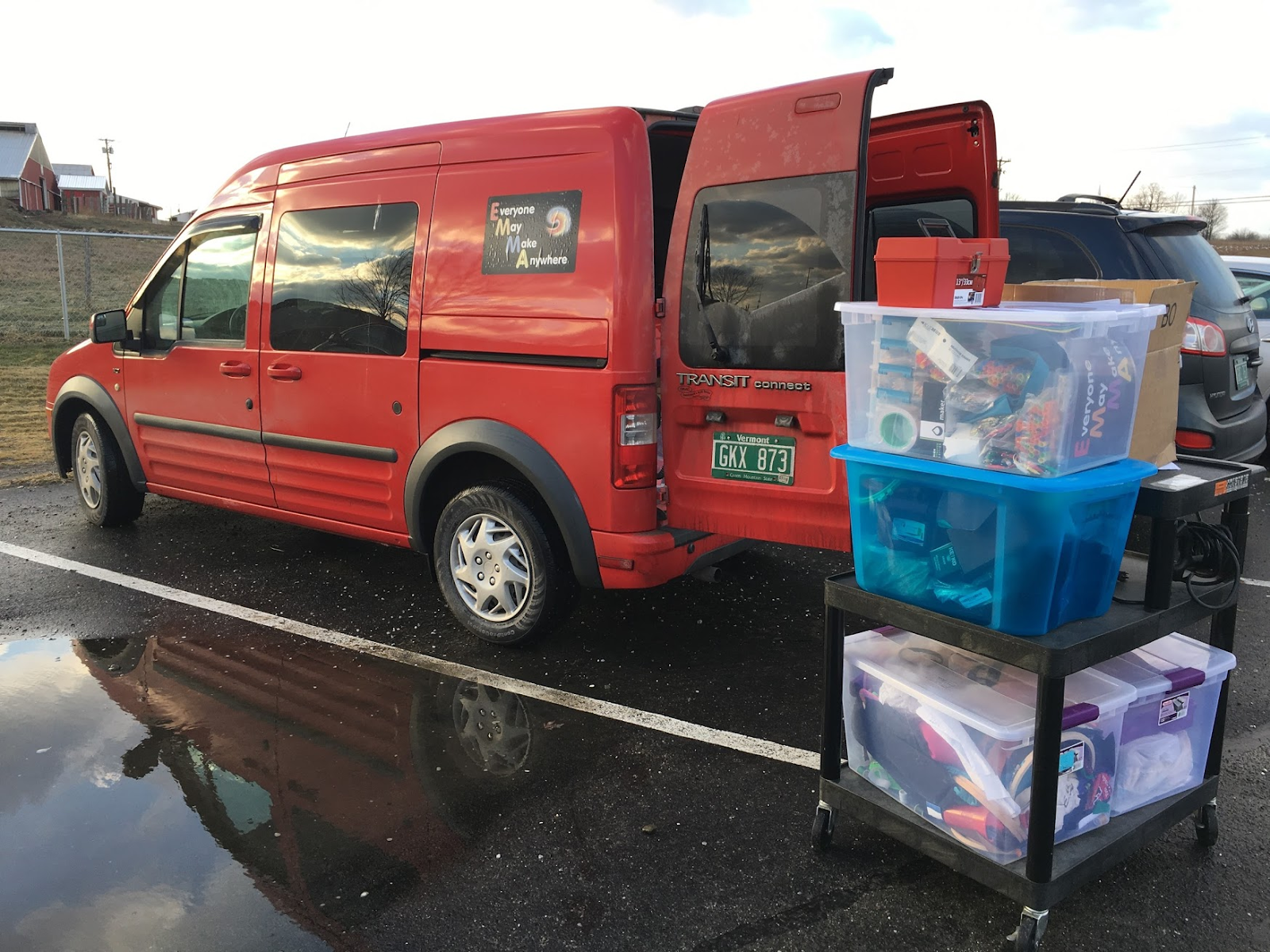
I love the fact that many maker spaces have sewing machines ranging from standard sewing machines to industrial sewing machines. I had recently picked up a new portable sewing machine for EMMA - my mobile studio for creating and making, but I had yet to hop on any of those sewing machines until yesterday.
Watching some fellow Generator members gathered around sewing machines and fabric in the Learning Lab, I decided to join the fun.
I picked up a red T-Shirt, laid down the Pillow Body People pattern pieces that Adriana had for us, and started to trace and cut! It has been 40 years since I had used a sewing machine. Since the sewing machine was 'ready to go', I didn't have to futz around with the dreaded threading of the needle!
The directions were minimalist, so I spent some time with 'close observing' of the Pillow People in various stages of creation around me.
As I was going through my 'making' I got to watch a magical process happen. A young girl approached the sewing machine, but stayed at a distance. Karen (one of the Generators sewing experts) invited her to join us and make with us. The young girl kept her distant mumbling that she didn't know how to use a sewing machine.
Within minutes, Karen had engaged her with the colorful upholstery samples and piles of available T-Shirts as they looked at some of the T-Shirt Hack bags on display! She started to imagine and talk about the type of bag she would like to make.
It didn't take long for her reluctance to transform to fully engaged and then to confident maker! By the time her bag was finished, she was begging her grandma to stay longer so she could make a a pillow person, too!
Again the magical maker formula of Inspiration, available Tools and Materials, and inviting Mentors were at play in turning an observer into a maker.
Nice job Generator for setting up an inviting place to Make with just the right tools!
Nice job Adraiana for setting up accessible maker materials in a way that inspired!
Nice job, Karen for being the perfect welcoming mentor!
The whole process reminded me of a tweet I saw recently with a 3 questions to help you assess the accessibility of your maker space. I forget where I saw this, but the questions were spot on and are firmly ingrained in the way I look at maker space and access!
I've been invited to join the Generator members during some of the maker sessions around sewing. Yesterday I felt very welcomed (no matter what my skills were). And suddenly I'm eager to find out when the next event is so that I can show up!
I had just finished my annual five day Create Make Learn Summer Institute and I was filled with ideas of what I might want to include in this two day event. The biggest problem was that I wanted to include TOO much! Stepping back I reached into my teacher toolbox and used a backward design approach to think about WHAT I wanted them to leave with at the end of the two days! I decided that what I really wanted them to be able to do is to “articulate WHY a Makerspace in MY School?” or at least be ready to lead that conversation with their colleagues.
Video Summary of Two Day Workshop
Too many educators approach me with one question -
“Can you give us a shopping list of things that we should consider getting for a maker space and where to get them?”
I try to resist answering that question until they can tell me their WHY. But the problem is that this is a chicken and egg situation. It’s hard to know your WHY if you have not experienced maker centered learning. You don’t know what’s possible. Of if you do, your understanding of what’s possible is limited to the areas you have experienced or what you have read. And since there is NO shortage of amazing materials about maker spaces (including shopping lists of resources) available online, educators are often feeling overwhelmed and confused. It was my goal that my two day workshop would provide teachers with a clearer understanding of some of the tools, technologies and materials often found in a maker space as well as WHAT type of impact having these available for students might have on learning.
This type of understanding does not simply come from looking at lists of maker space supplies. This type of understanding does not just come from sitting around talking about pedagogy. This type of understanding does not come from creating a large collection of STEAM based lesson plans. This type of understanding comes from from all of the above combined with experiencing the learning process that happens as you Create and Make.
It was my challenge to create a HANDS-ON MINDS-ON experience that left a group of teachers feeling empowered to have deeper conversations around maker spaces in their schools.
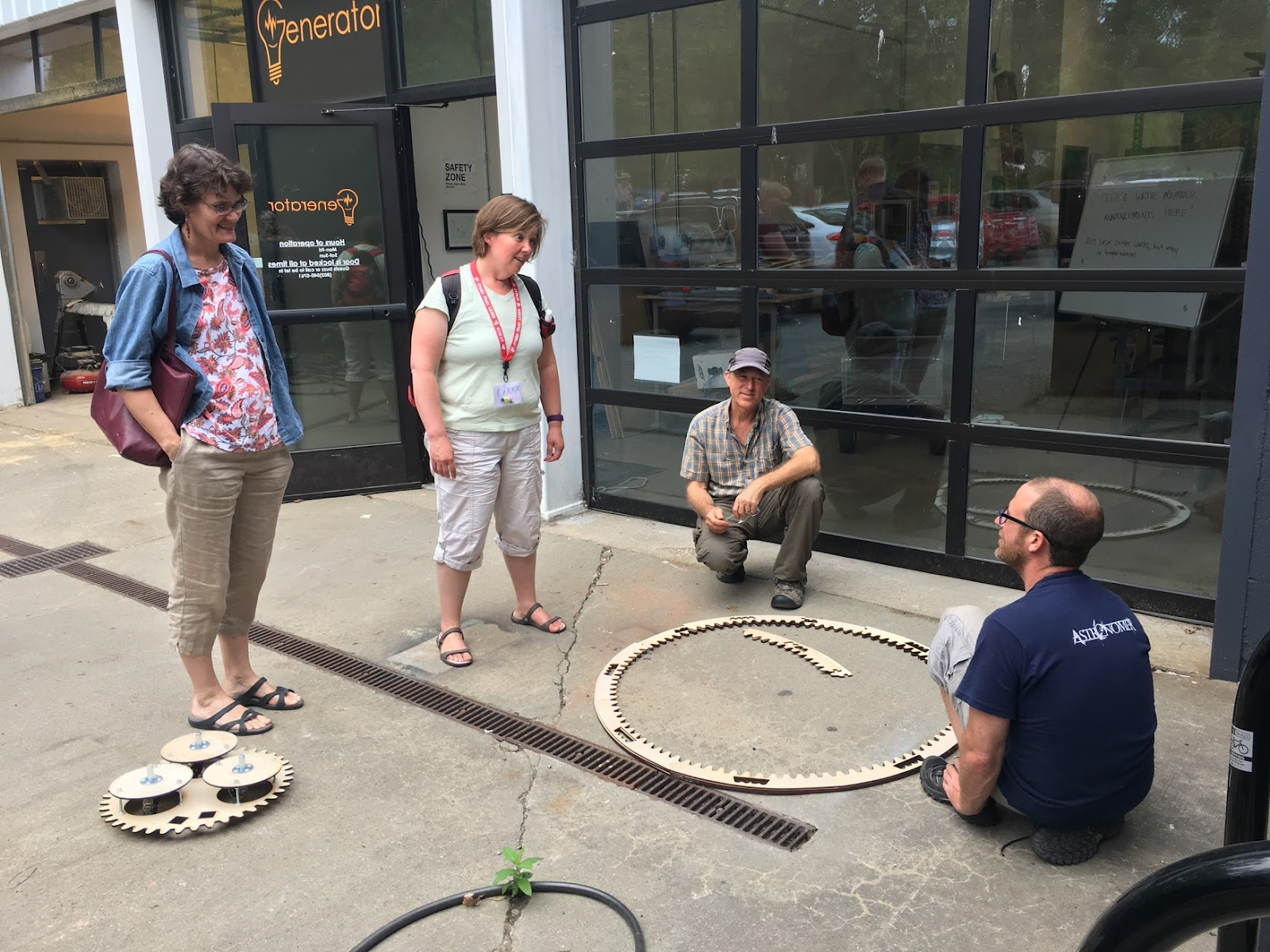
It all started with picking two great locations for the workshop. We kicked off the workshop at the Generator - a community maker space in Burlington Vermont, followed up with Day 2 in a school maker space - Studio B (the BTC maker space in Burlington Schools) The locations of the workshops were instrumental to helping our group (mostly PreK - 8 teachers) start to understand the possible WHY of a makerspace. The locations for our workshop also highlighted how important that we examine our WHY as part of an interconnected system - a community of makers, educators, artists, inventors, problem solvers, and innovators shaping the future. Our Why should be shaped by a greater understanding of how each of us contributes to the system and how we can help each other towards a greater collective impact.
In the spirit of backward design, the location helped these teachers of younger learners understand where their young learners COULD end up in just a few years. It’s an incredible responsibility to be charged with creating the next generation of inventors, problem solvers, and innovators. What do we do to help teachers prepare for this daunting tasks?
One of the best things you can do is to hold workshops in locations filled with inspirations and examples of what their YOUNG LEARNERS might be CREATING and MAKING in THEIR future.
Too many teachers ask that a workshop give them something they can DO TOMORROW in THEIR CLASSROOM. We need to think BIGGER than this! Yes, the workshop should also provide that practical thing you can use tomorrow, but more importantly it should leave you inspired to prepare students for THEIR future.
As we toured the Generator, I asked teachers to take as many pictures as they could of INSPIRATION that they could use to better understand what their students might be able to create someday. I also suggested that they take pictures of tools and materials that might be useful in a makerspace. This would be the beginning of the LIST of tools and materials they asked for in our earlier conversation. THEY would build this list together from their experience over the next two days! Trying to model that a teacher’s job is not to provide a ready made solution, but to help students ask the right questions and design a solution to questions like (How do I create a makerspace in my school), I was determined not to provide a recipe but to help them create their own individual design that matched their WHY!
It was my goal that their question would move from “What should I buy and where do I get it?” to “How do I set kids on a journey to create and make amazing artifacts or solutions to problems.”
Educators inspired by Generators Member Projects
The locations of our two day workshop set the stage perfectly for this to happen.
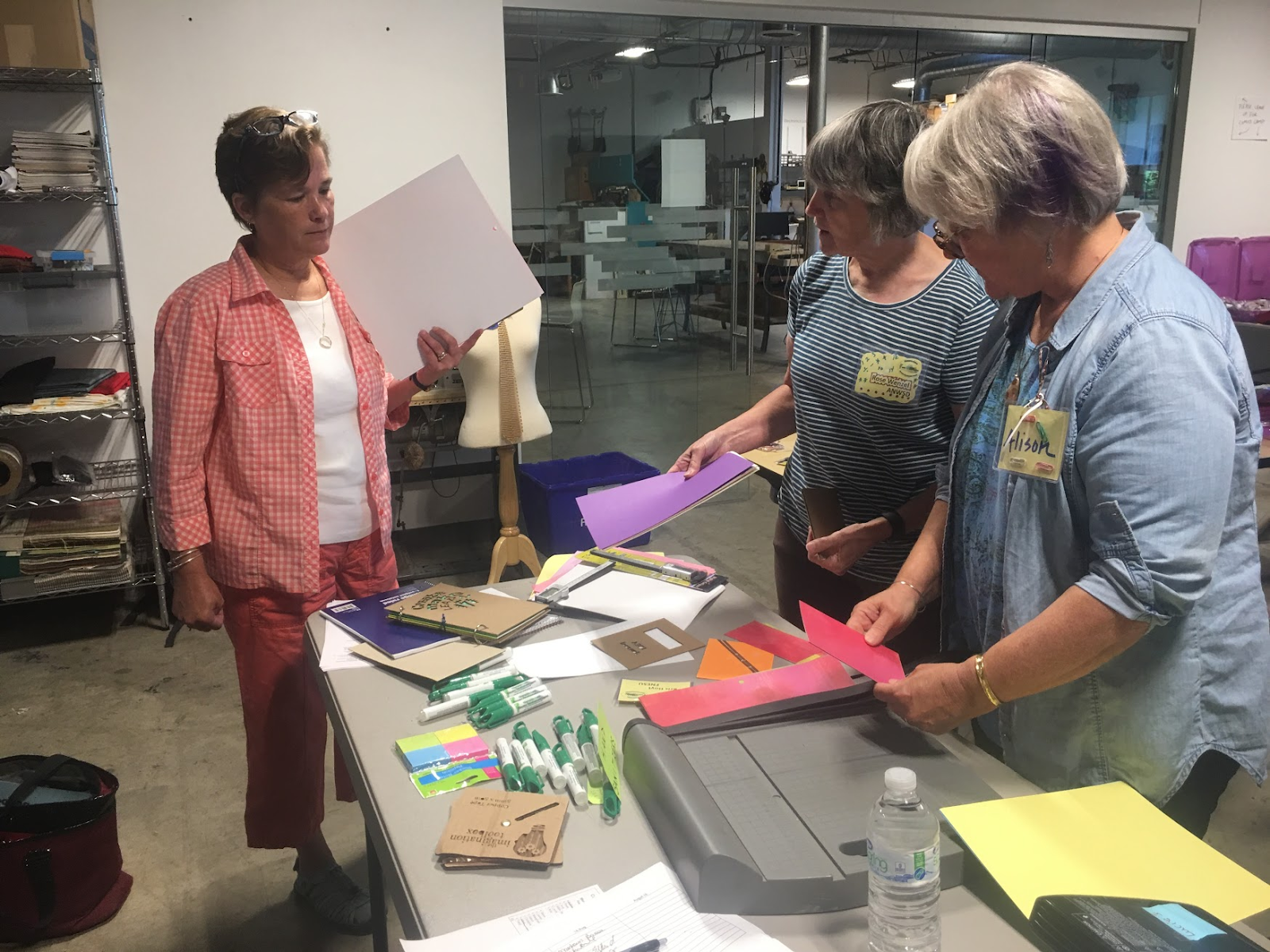
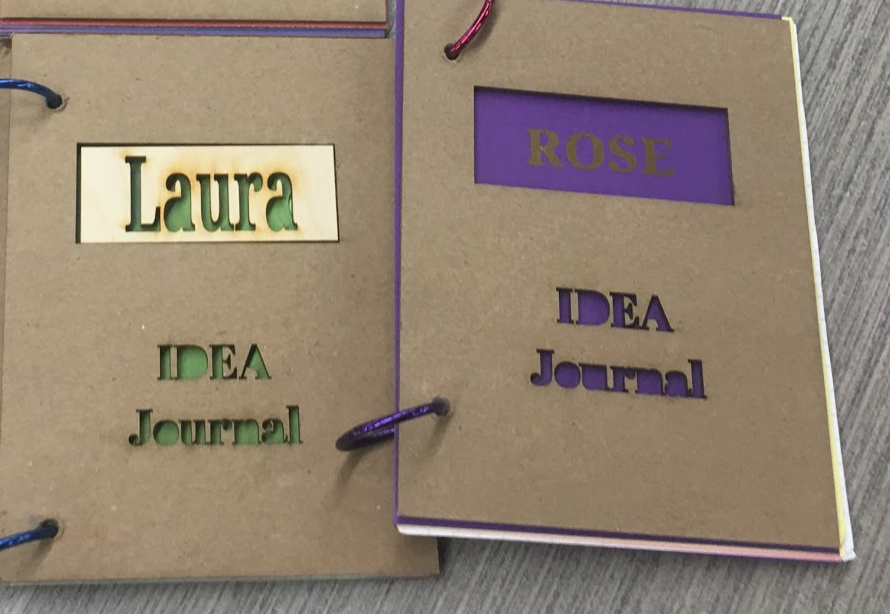
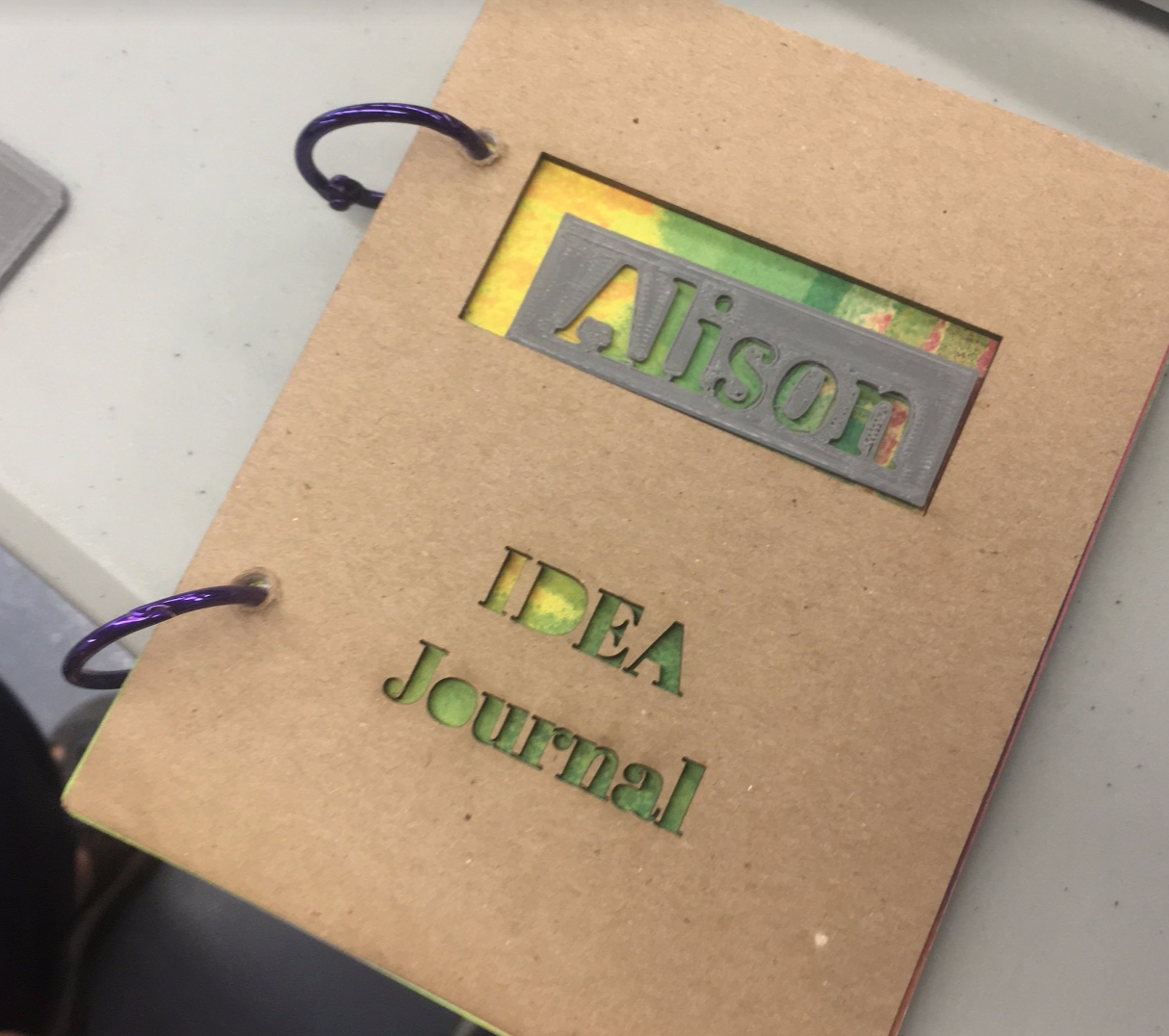
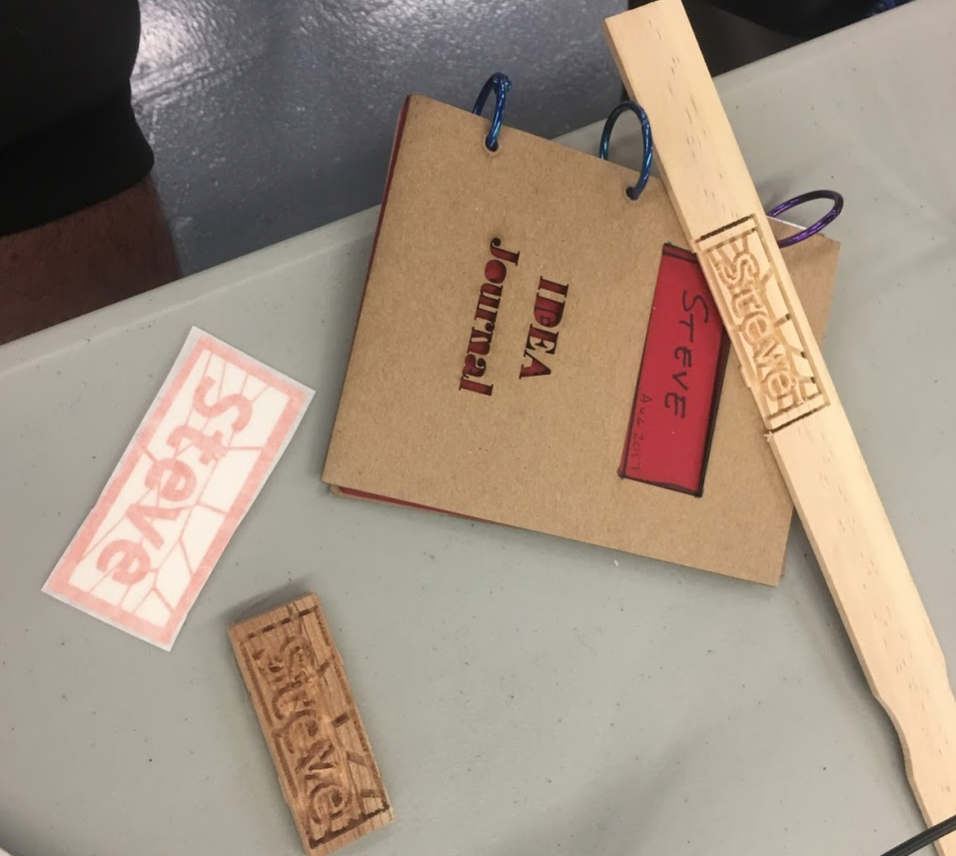
After our tour of the Generator, we jumped into a Make and Take that not only left teachers with their own IDEA Journal where they could flesh out their WHY, but also with a clearer understanding of the process of learning and making with tools like vinyl cutters, CNC machines, laser cutters, 3D printers. The consensus was that even though many of the teachers might NOT USE THIS TOMORROW, they NOW UNDERSTOOD the difference between each of these technologies. They knew the difference between additive technology and subtractive technology. They knew the pros and cons of choosing a laser cutter vs a CNC machine to solve a problem or create an artifact.
Creating and Making our Idea Journals
Using a Laser Cutteror a Vinyl Cutter
Or a 3D Printer
Or perhaps a CNC machine
So many choices! So much fun to explore the possibilities as we learn new skills.
By the end of the first day, this group of educators agreed that they knew which tools were more accessible to their learners and which ones would require students to develop pre-requisite skills. They could design experiences in their classroom that helped build those skills. They started to see connections between some real world applications to content in their curriculum (i.e. X, Y, Z axis) They started to understand tools and processes that their students might have available in the not too distant future. Even if some of the teachers did NOT have these technologies in their classroom, they knew they were preparing students to use tools that might be in their school soon (if not already) or might be accessible in their community through partnerships with community maker spaces like the Generator.
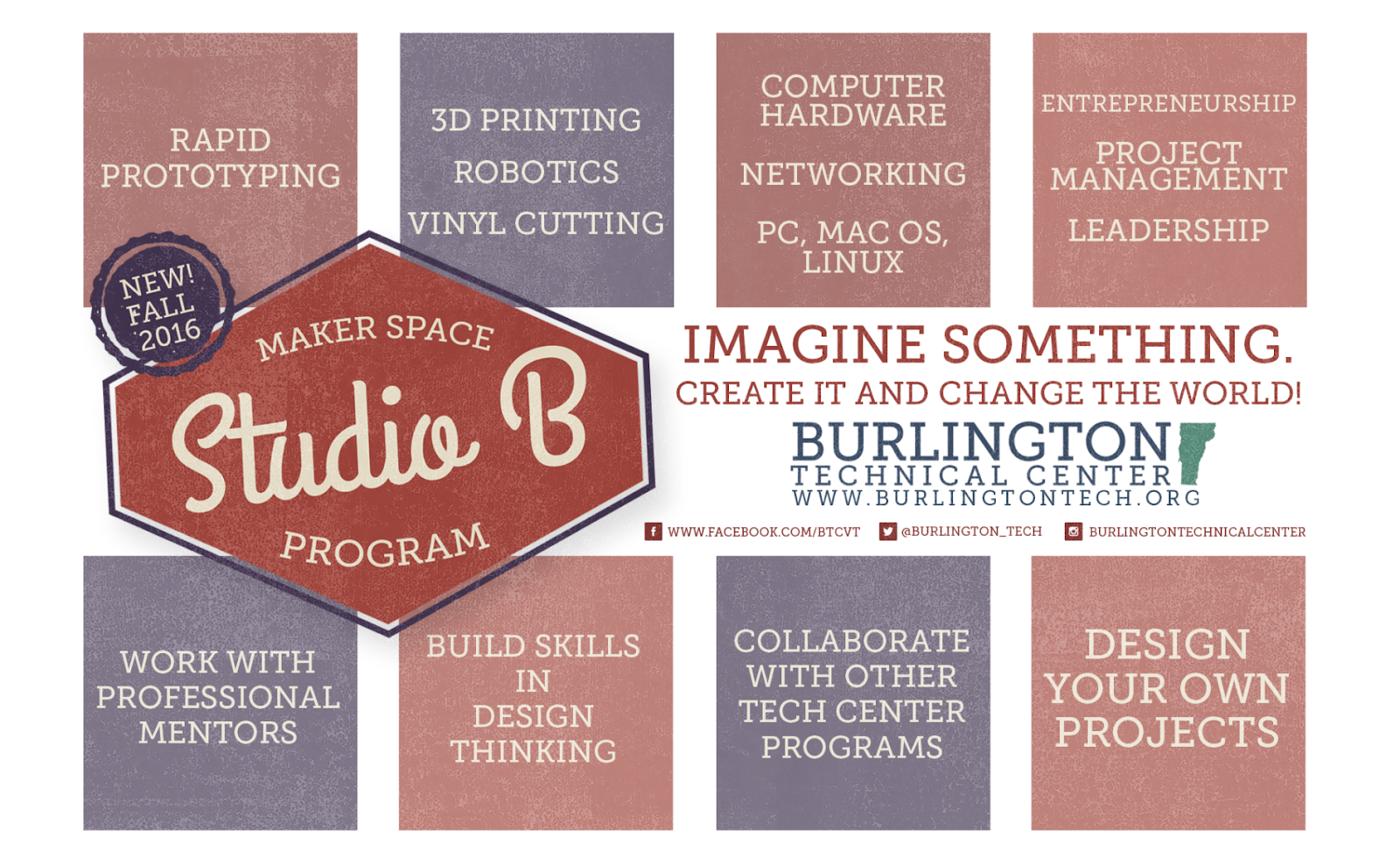
On Day 2 we moved to a school maker space Studio B - a school maker space( at the Burlington Technical Center. Too few teachers are aware of the changing role that Career and Technical Education can play in the lives of our students. The 16 Career and Technical Education Centers that serve ALL of Vermont’s students are not the “vocational programs” that many of us experienced when we were students. They provide amazing opportunities for students who thrive in hands-on minds on environment using some of the most advanced technologies in the industry. They prepare our students to succeed in college and post-secondary training and have several dual enrollment college opportunities built into them.
As Vermont teachers help advise and mentor students in developing personal learning plans for their educational journey, both our teachers and our students need increased awareness of the Career and Technical Center opportunities available in their school district. Our Day 2 venue did this in so many ways, including the long walk to the bathroom as we passed classrooms labeled Welding or Aviation. Having spent 15 years teaching in a Career and Technical Center, I can attest that the students who are filling our current school makerspaces absolutely need to know about these opportunities; and as teachers we can help increase their awareness by increasing our own awareness to better mentor them through their personal learning plans.
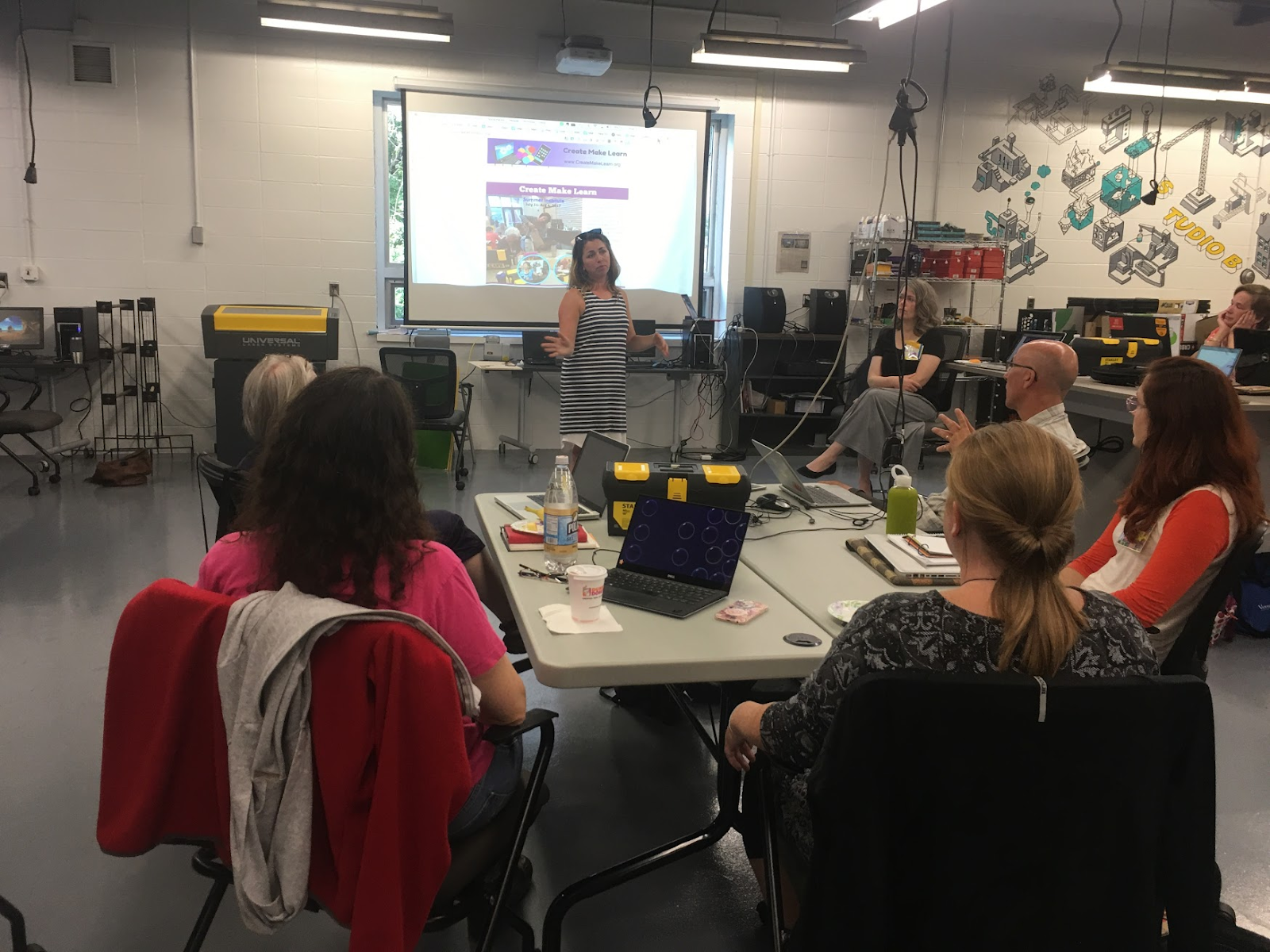
Courtney welcomes us to Studio B
We were welcomed to Burlington Technical Center by Courtney Asaro who had helped design and set up the Studio B makerspace just last year. We had the added bonus of having Courtney talk to us about her work with younger learners at Flynn Elementary. Courtney described how SHE and her young students would be collaborating with the Burlington Technical Center in the upcoming school year. She also shared examples of how Flynn Elementary students had collaborated with Generator members, driving home the importance of understanding the power of leveraging the community as you develop your maker education journey.
Our morning conversation was rich and had a natural flow to it as teachers debriefed the previous day and prepared for our second day of making. Listening to what surprised them, what was challenging, and what inspired them revealed that they were really starting to understand their “WHY” and how a makerspace might fit into their school. Seeing similar technologies in a school maker space as they had seen earlier at the Generator, (laser cutter, 3D printer, vinyl cutter, CNC machine, power tools, hand tools, and more) our group of educators were less interested in the ‘tools’ and more interested in the process of making. The shift in the conversations was a perfect set up to the experiences I had designed for the day.
Our Day 2 workshop design revolved around the multi-disciplinary Transferrable Skills that Vermont teachers are being asked to design their own learning around.
By the end of the morning, our teachers had experienced how increased confidence with circuits and code could equip students with tools for Creative and Practical Problem Solving, Mathematical Standards of Practice and Science and Engineering Practice found in Next Generation Science Standards.
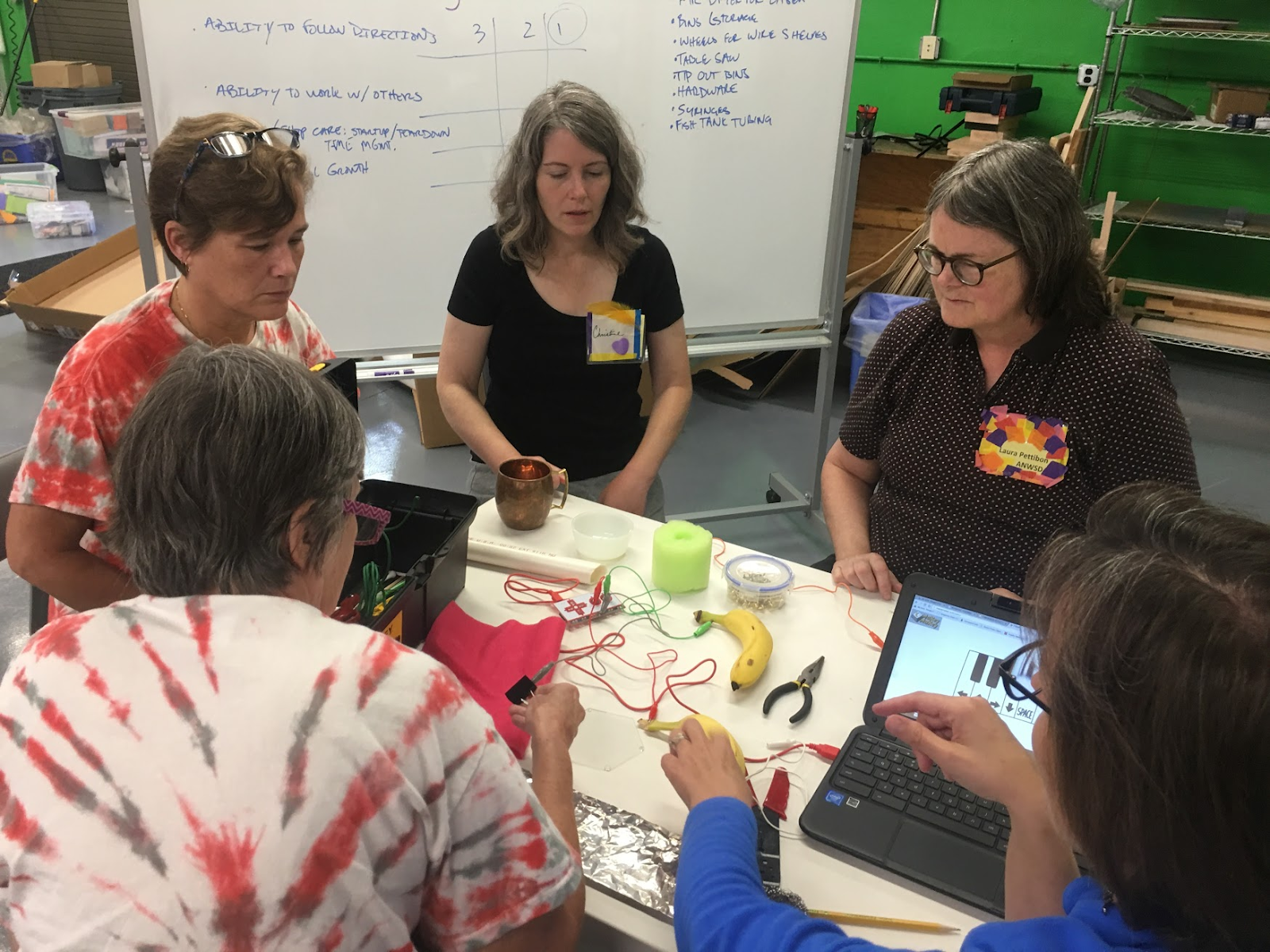
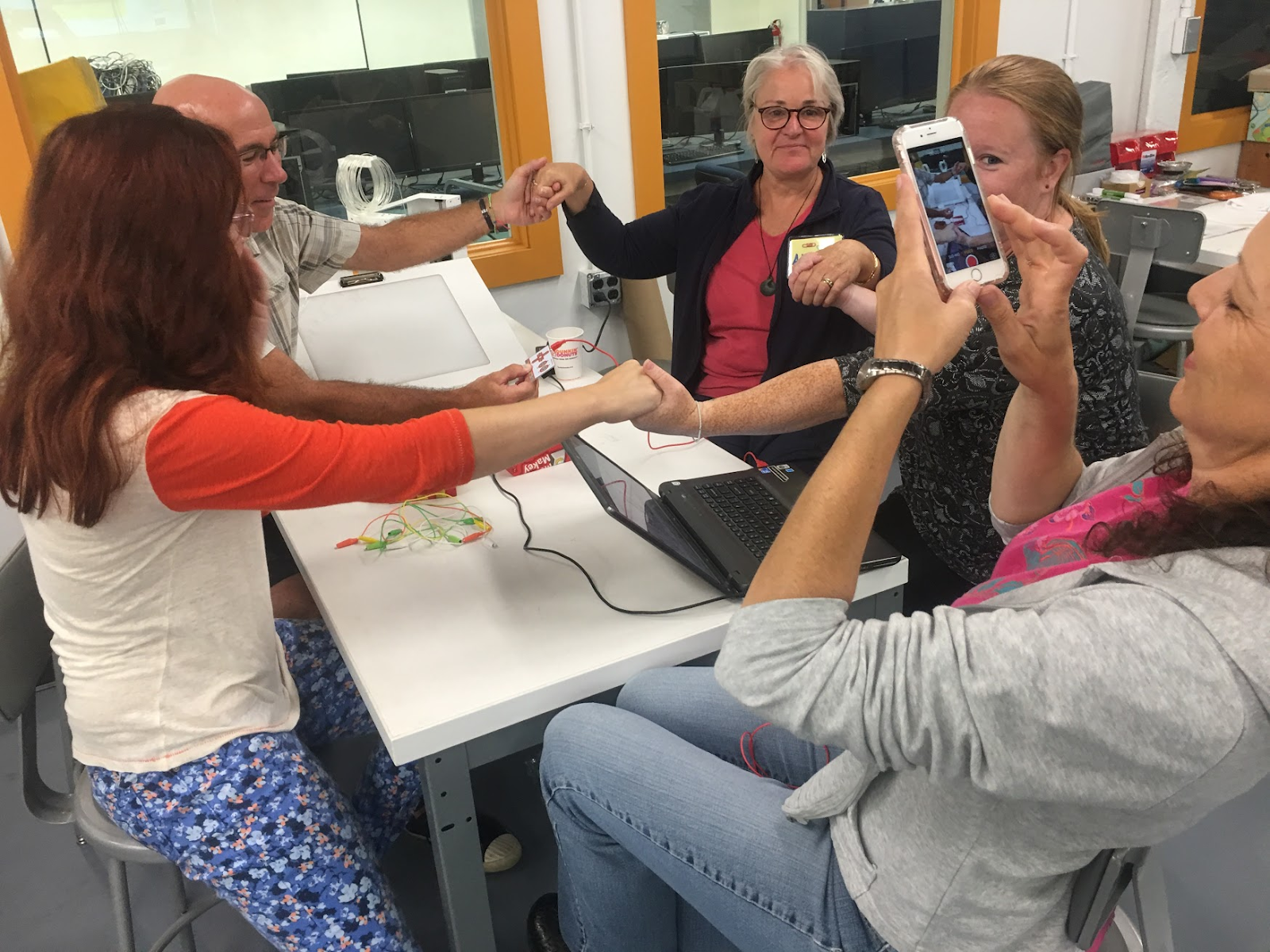
They had experienced the fun and joy of creating their own inventions using a Makey Makey. I shared stories with concrete examples from classrooms around Vermont of students demonstrating Self Direction, Responsible Citizenship, and Integrated and Informed Systems through Creating and Making in their schools. Their understanding of where coding fit into the big picture grew as they experienced an unplugged coding activities that set them up to a successful experience using the Scratch coding environment to control their own inventions and physical objects with a Makey Makey. Laughter and joy combined with persevering through challenges lead to discussions about growing MINDSET as well as SKILLS in our students.
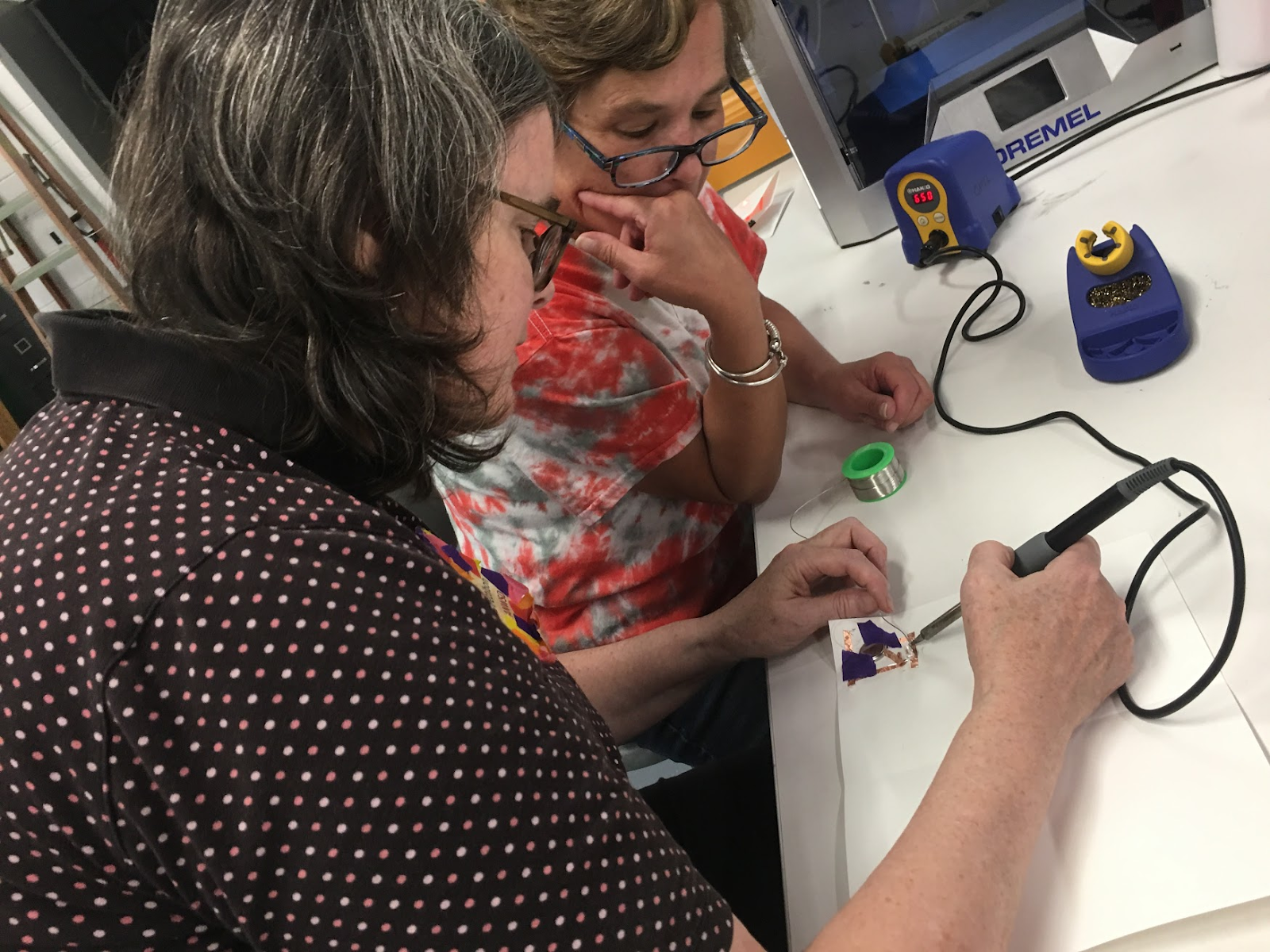
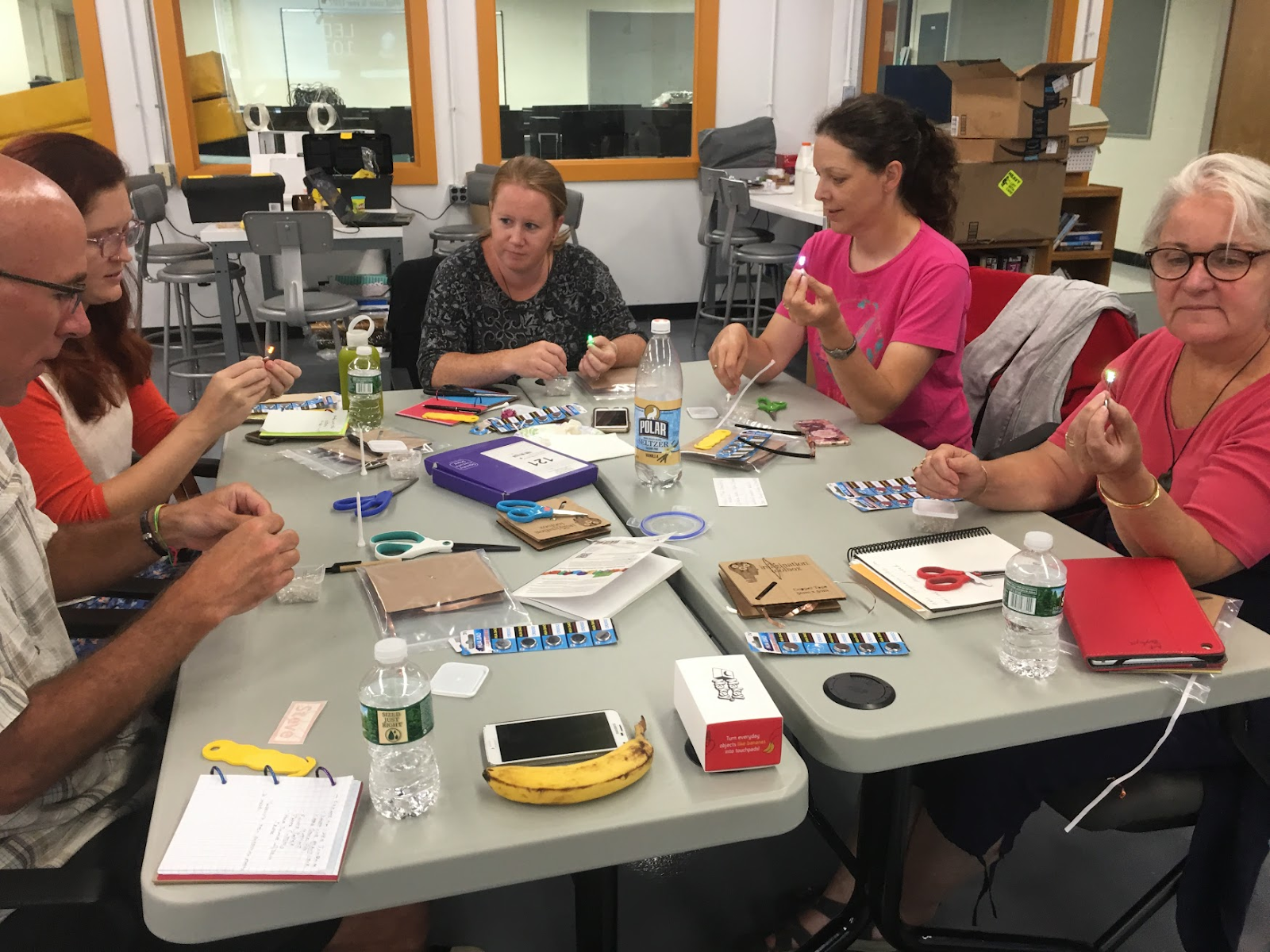
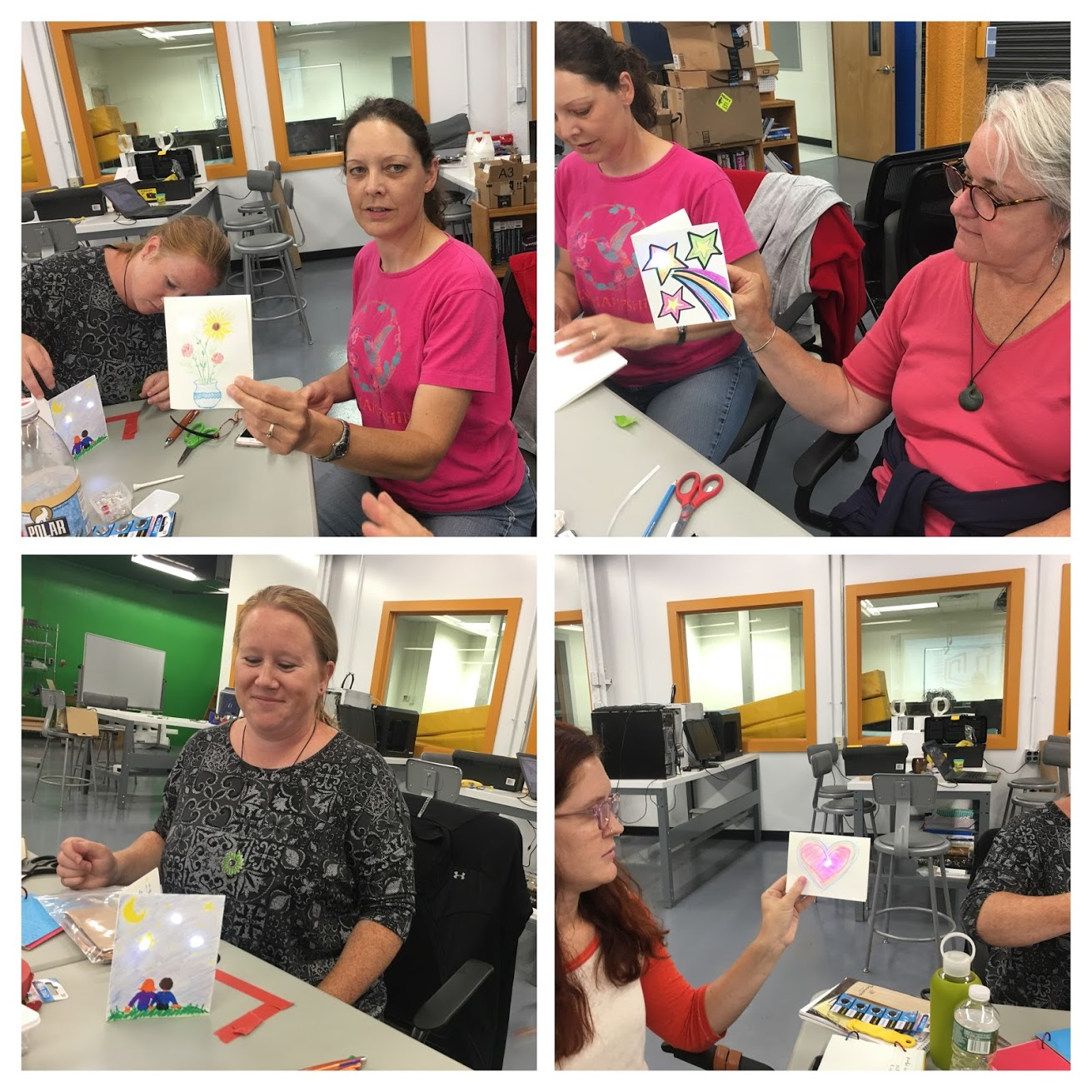
The workshop ended with another MAKE and TAKE that used Paper Circuits to expand the possibilities of Clear and Effective Communications. Equipped with new skills (from designing closed circuits to soldering) and examples of how various teachers and students had used these skills in their curriculum, our teachers started to imagine ways they could integrate creating and making with circuits in their own learning spaces.
The conversations about pedagogy happened naturally through our making, through our questions, and through our sharing of ideas that emerged throughout the two days. However, the experience did not stop them from asking one more time -- “Do you have a LIST of supplies for us?” I pointed to the supplies we had used over the two days and also to a few great resources online that included such lists and I smiled when I heard one of them exclaim.. “Now I know what this stuff is. I would have had no idea what a jumper cable was and why I might need it before.”
I encouraged them to keep taking and collecting picture of materials, to keep sharing tools, materials, processes they discover, but mostly to keep asking WHY as they looked over each item in a pre-populated makerspace list of resources and to look through these lists with a LENS that included their WHY! Yes, there WHY would change over time and should not be static, but hopefully these two days helped to create a lens by which they could continue the journey of creating a makerspace in their school in a powerful and meaningful way.
I just realized that I haven't posted anything in this blog since April - can that be? Thinking about the past few months, I realize why. I've been immersed in planning what turned out to be one of the most rockin' Innovation Lounge experience yet for Dynamic Landscape Conference sponsored by Vita-Learn and VSLA.
and OMG did it rock! Vermont is filled with the most amazing innovative educators!
If you weren't there.. here is a glimpse into the two days in the Innovation Lounge.
Our students are so lucky to have such wonderful folks guiding them. One of the best parts of this year's innovation lounge was that it was filled with student presenters. We had over 100 teachers and students exhibiting innovative practices for teaching and learning over the two days in the Innovation Lounge alone. Add that to all who presented in regular workshop sessions and you will soon realize why the 2017 Dynamic Landscape conference was an amazing event focused on authentic student voice.
This year we have
-- a two day Intro to Making option in Rutland on July 13 - 14
-- a two day Media Making option in Burlington on July 31 - Aug 1
along with our signature 5 day hands on Institute in Burlington July 31 - Aug 4.
Here is a list of the Innovation Lounge exhibitors I've been working with over the past few months! LUCKY ME! and Lucky YOU if you got to interact with them at Dynamic Landscape and even more Lucky students if you were inspired by this year's Innovation Lounge to try something new in your school.
Mon Morning
Experience...
Mon May 22
Design Challenge with Pinbox 3000
Create Make Learn & Cardboard Tech
Pete and Ben from Cardboard Instantute
Mon May 22
Create Animations
Rice Memorial
Tony Galle
Mon May 22
Making Media Challenge & Showcase
Create Make Learn Community
Mon May 22
Hero's Journey with Pinball
Hunt Middle School
Lee Slocum-Orlando
Mon May 22
MVU Library Makerspace
MVU
Kim Hamel
Mon May 22
3D printing Fractal Towers
Missiquoi Valley HS
Richard Ballard
Mon May 22
Paper Circuits Hands on Exploration
Jill Dawson
Jill Dawson
Mon May 22
Circuit Project using Touchboards
Williston School
Leah Joly
Mon May 22
Making Kaleidoscopes
Edmunds Middle School
Daryl Kuhn & students
Mon May 22
Lego Design Challenges
Shoreham Elementary School
Abby Adams
Mon May 22
Learning to Code with Robot Rodeo & Robot Rodeo Challenge
Mills River
Joe Bertelloni & Students
Morning Afternoon
Experience...
Mon May 22
Pinball Design Challenge with Pinbox 3000
Cardboard Tech Instatute & Create Make Learn Community
Mon May 22
Experience Augmented Reality
Rutland City
Clarena Renfrow
Mon May 22
Making Media Challenge & Showcase
Create Make Learn Community
Mon May 22
Experience Minecraft
St. Albans City School
Cathy Cameron Muscente & students
Mon May 22
Virtual Reality and Game Design
Center for Tech Essex
Lorand Moore & students
Mon May 22
Crossett Brook Library Makerspace
Crossett Brook MS
Jen Hill + students
Mon May 22
3D Printing & Finishing + VR and 3D PRints
Benson School
Rodney Batschelet & student
Mon May 22
Robotic Competitions
Richford School
Kris Hoyt
Mon May 22
Learning to Code with Robot Rodeo / BluBot Demo
SVSU Schools
Sally Bisaccio
Mon May 22
Lego Design Challenges
Shoreham Elementary Schoo
Abby Adams
Tuesday Morning
Experience...
Mon May 22
Design Challenge with Pinbox 3000
Cardboard Tech Instatute & Create Make Learn Community
Mon May 22
Low Tech Design Challenge with Center for Tech at Essex
Center for Technology Essex
Caty Wolfe and students
Tue May 23
Experience 360 Video
Rutland Central
Erica Zimmer
Tue May 23
Making Media Challenge & Showcase
Create Make Learn Community
Tue May 23
Tangible Learning With Osmo
Fletcher School
MC Baker + student
Tue May 23
Bristol Elementary Library Makerspace
Bristol Elementary
Kyra Ginalski
Tue May 23
3D Vermont
Williston Central School
Ellen and Aaron & students
Tue May 23
Wifi Connected Book Demo (IoT)
Jill Dawson
Jill Dawson
Tue May 23
Making Community/ Burlington Schools/ Generator
Flynn Elementary / Generator
Nick Mack and students
Tue May 23
Burlington Tech Center Makerspace
Burlington Technical Center
Courtney Asaro and students
Tue May 23
Lego Design Challenges
Shoreham Elementary Schoo
Abby Adams
Tue May 23
Learning to Code with Robots Rodeo / Blu Bot Games
Orchard School
Donna MacDonald Steven Schmidt & Students
Tuesday Afternoon
Experience...
Tue May 23
Make Green Screen Movies with WeVideo
South Burlington
Lauren Parren
Tue May 23
Making Media Challenge & Showcase
Tue May 23
Creating Games in Math Class
South Burlington High School
Kristine Harootunian + students
Tue May 23
3D Design for Animals
Milton HS / Generator
Courtney Reckord & students
Tue May 23
Pinball Design Challenge - Enchance with Circuits
Create Make Learn / Cardboard Instantute/ Center for Tech Essex
Tue May 23
Lego Design Challenges
Shoreham Elementary Schoo
Abby Adams
Tue May 23
Learning to Code with Robots Rodeo
Richmond School
Darcie Rankins & Students
Tue May 23
Essex High School Library Makerspace
Essex High School
Martine Gulick
Tue May 23
Play to Learn/ Learn to Play & Design Challenges
Center for Technology Essex
Caty Wolfe
Tue May 23
Vermont Robotic Teams Return from World Competition

 I love the fact that many maker spaces have sewing machines ranging from standard sewing machines to industrial sewing machines. I had recently picked up a new portable sewing machine for EMMA - my mobile studio for creating and making, but I had yet to hop on any of those sewing machines until yesterday.